Supporting Autonomy: Reimagining Vision Accessibility Measures at Positive Exposure
Supporting Autonomy: Reimagining Vision Accessibility Measures at Positive Exposure
Speculative mobile app design dedicated to address existing accessibility gaps for Blind and Low-Vision (BLV) individuals in gallery visit settings.
Speculative mobile app design dedicated to address existing accessibility gaps for Blind and Low-Vision (BLV) individuals in gallery visit settings.
Timeline
Timeline
10 weeks (Mar - May 2026)
10 weeks (Mar - May 2026)
10 weeks (Mar - May 2026)
Team Members
Team Members
3 Fellow Pratt Institute graduate students
3 Fellow Pratt Institute graduate students
3 Fellow Pratt Institute graduate students
My Role
My Role
Research Lead & Design Contributor
Research Lead & Design Contributor
Research Lead & Design Contributor
District 75 is NYC's specialized public school district, serving approximately 24,000 students with significant disabilities across all five boroughs. Art 75 is its annual student gallery exhibition that is open to students, families, and the public.
This year, Positive Exposure is the designated gallery to host Art 75 and consulted Pratt Institute students for accessibility improvements.
Challenge
A thoughtful system introduced to a new space. Art 75 had a working vision access setup designed by blind and low-vision (BLV) individuals: clockwise navigation sequence, consistent QR code placement next to each artwork, and more. Moving to Positive Exposure this year disrupted its logic and surfaced new gaps to address.
A wide spectrum of needs. BLV is not a single condition. Visitors may have different levels of vision, different assistive technologies, and different priorities for accessing content and moving through the physical space.
We Delivered:
A client presentation bringing together:
synthesized findings on current BLV accessibility measures in gallery settings
design recommendations grounded in those findings
a mid-fidelity prototype demonstrating what an improved visitor experience could look like in practice.
District 75 is NYC's specialized public school district, serving approximately 24,000 students with significant disabilities across all five boroughs. Art 75 is its annual student gallery exhibition that is open to students, families, and the public.
This year, Positive Exposure is the designated gallery to host Art 75 and consulted Pratt Institute students for accessibility improvements.
Challenge
A thoughtful system introduced to a new space. Art 75 had a working vision access setup designed by blind and low-vision (BLV) individuals: clockwise navigation sequence, consistent QR code placement next to each artwork, and more. Moving to Positive Exposure this year disrupted its logic and surfaced new gaps to address.
A wide spectrum of needs. BLV is not a single condition. Visitors may have different levels of vision, different assistive technologies, and different priorities for accessing content and moving through the physical space.
We Delivered:
A client presentation bringing together:
synthesized findings on current BLV accessibility measures in gallery settings
design recommendations grounded in those findings
a mid-fidelity prototype demonstrating what an improved visitor experience could look like in practice.
Design Question
How might we improve existing accessibility measures to support the autonomy of BLV visitors, giving them meaningful control over their gallery experience?
Why autonomy?
Through our research, we identified BLV user needs that all point to the same underlying issue:
Current a11y measures lack flexibility for BLV users to have control over their own experience.
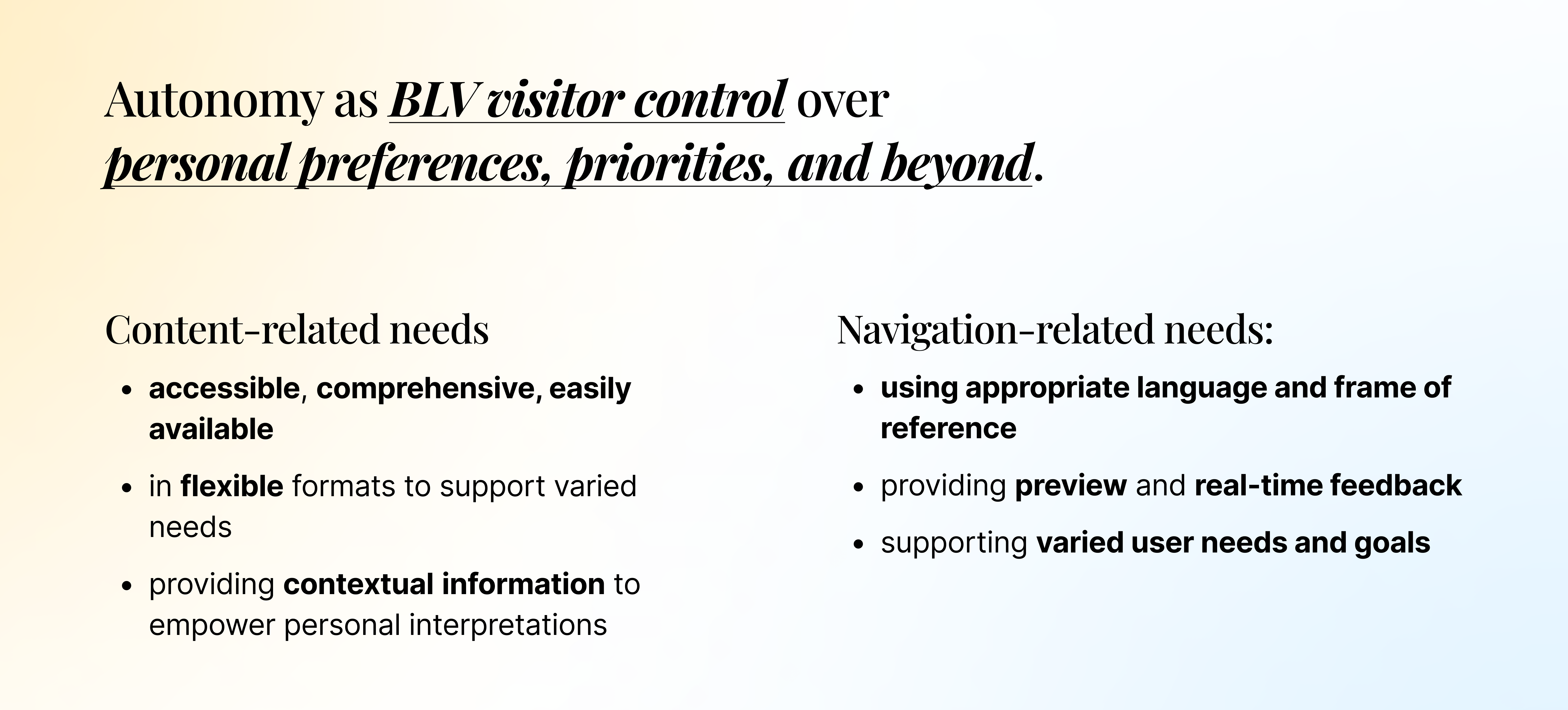
As the Nielson-Norman Group defines autonomy to be "the ability to use an interface, product, or service in a way that aligns with personal preferences and priorities," we decided reframe and focus on supporting autonomy throughout the entire gallery visit experience.
Design Process (see below)
Design Question
How might we improve existing accessibility measures to support the autonomy of BLV visitors, giving them meaningful control over their gallery experience?
Why autonomy?
Through our research, we identified BLV user needs that all point to the same underlying issue:
Current a11y measures lack flexibility for BLV users to have control over their own experience.
As the Nielson-Norman Group defines autonomy to be "the ability to use an interface, product, or service in a way that aligns with personal preferences and priorities," we decided reframe and focus on supporting autonomy throughout the entire gallery visit experience.
Design Process (see below)
Research
We began our research by taking a look at the entire user journey (image below) for BLV gallery visitors, drawing from first-person recounts on Reddit as well as existing studies.
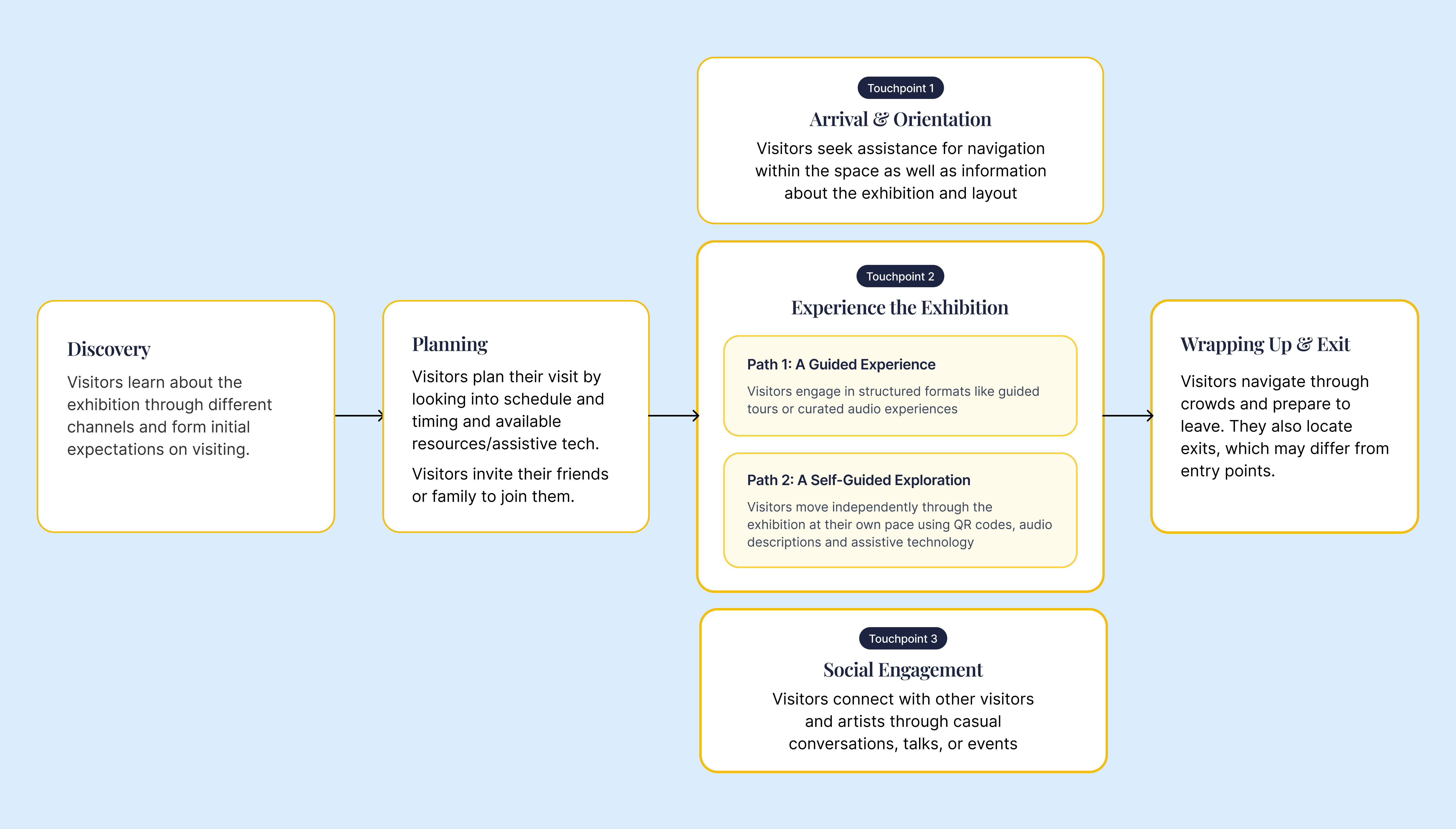
Across both sources, we discovered that BLV individuals reported many barriers as they experience the exhibition both in the context of comprehending the artworks and navigating the gallery layout.
Research
We began our research by taking a look at the entire user journey (image below) for BLV gallery visitors, drawing from first-person recounts on Reddit as well as existing studies.
Across both sources, we discovered that BLV individuals reported many barriers as they experience the exhibition both in the context of comprehending the artworks and navigating the gallery layout.
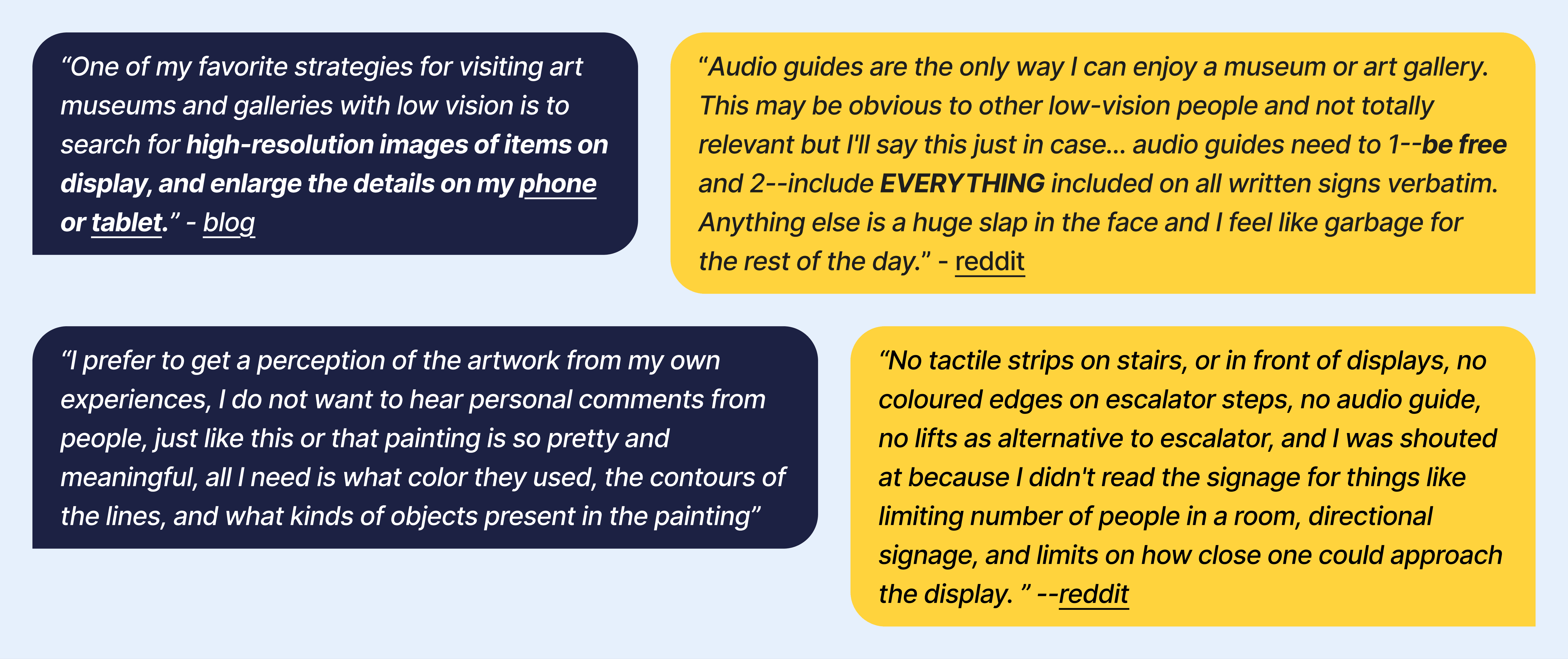
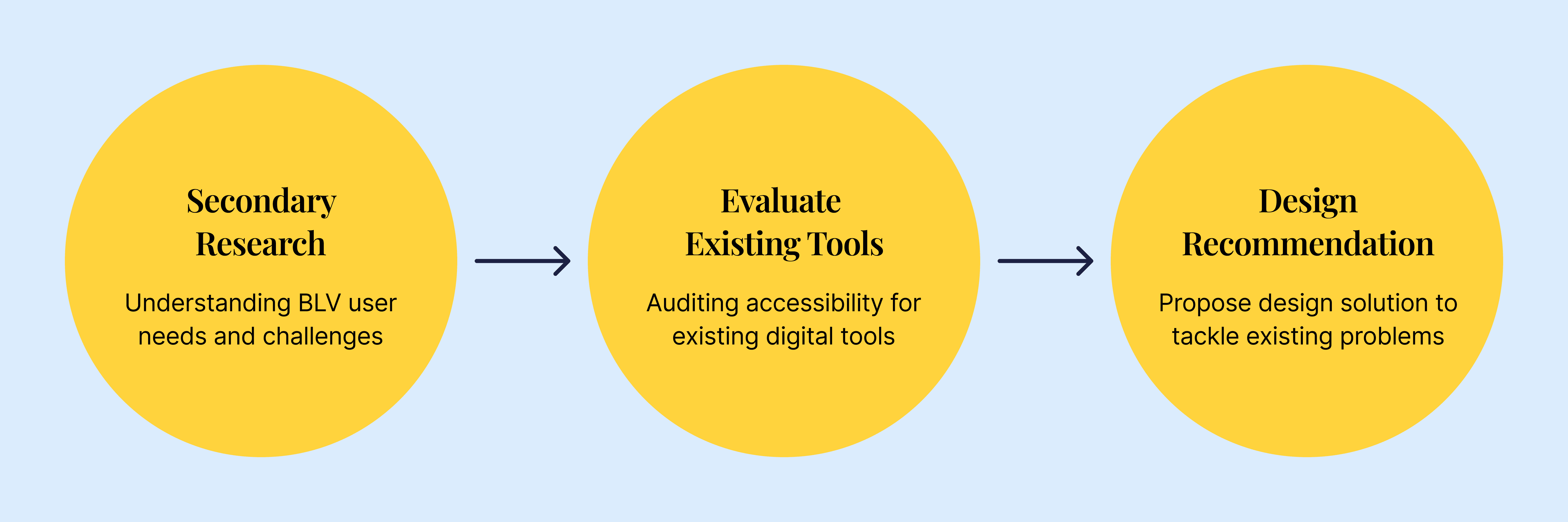
This allowed us to focus on 2 main aspects of BLV user needs: in content and navigation, on which we then surveyed more relevant studies to build further understanding. At the same time, we adjusted our design question to focus on autonomy, using it as a framework to organize our findings.
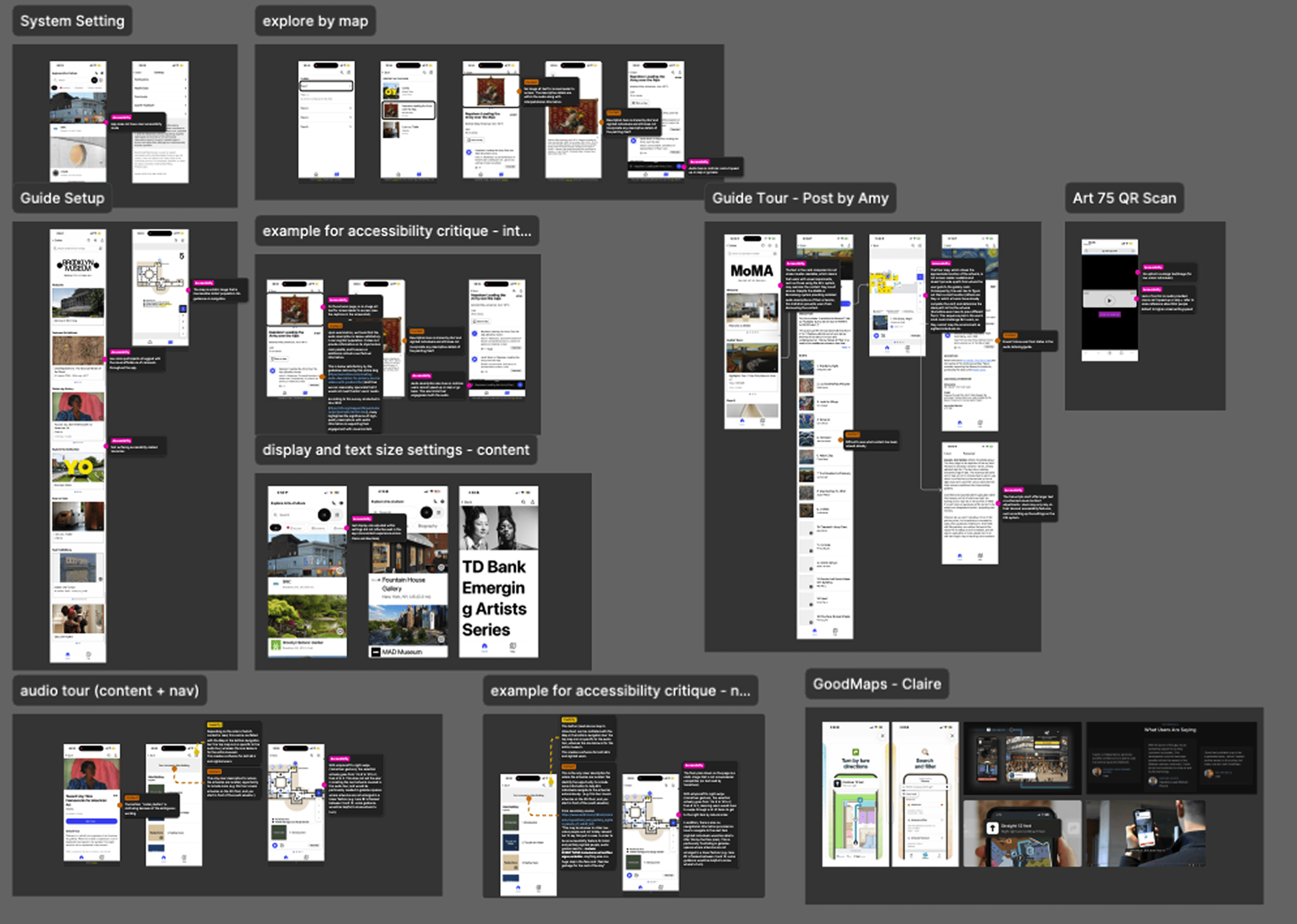
We also looked at existing solutions, conducting accessibility audits on assistive technologies such as Good Maps, NavCog, and digital app for museum accessibility Bloomberg Connect. While we are not BLV individuals ourselves, we evaluated these against research insights.
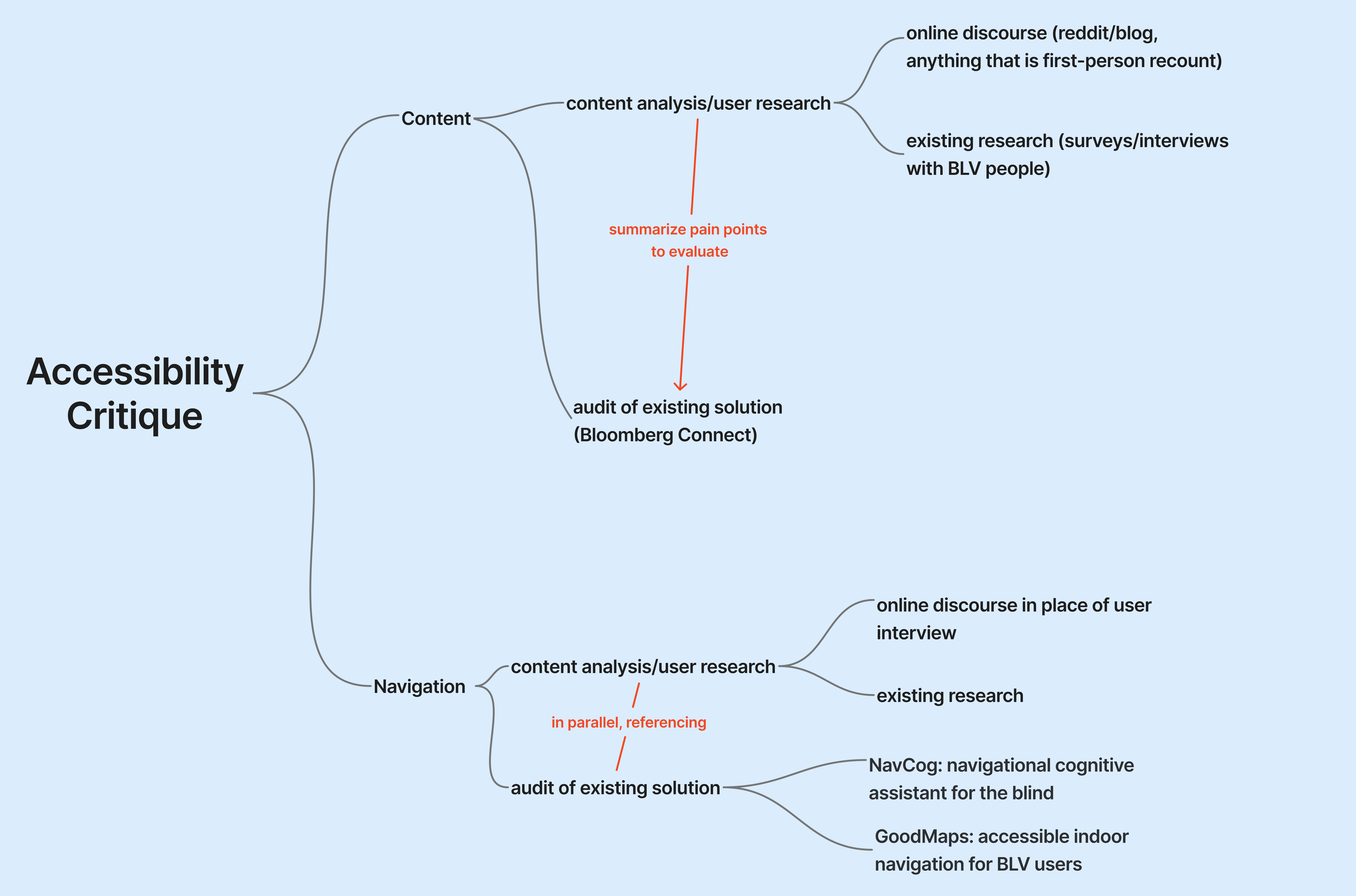
Our findings across user research and audits consolidated into an Accessibility Critique.
This allowed us to focus on 2 main aspects of BLV user needs: in content and navigation, on which we then surveyed more relevant studies to build further understanding. At the same time, we adjusted our design question to focus on autonomy, using it as a framework to organize our findings.
We also looked at existing solutions, conducting accessibility audits on assistive technologies such as Good Maps, NavCog, and digital app for museum accessibility Bloomberg Connect. While we are not BLV individuals ourselves, we evaluated these against research insights.
Our findings across user research and audits consolidated into an Accessibility Critique.
Synthesis
Our research yielded 3 critical insights:
Autonomy means choice, not just access.
BLV visitors need control over modality, pacing, depth of information, and navigation style (point to point or free roam), NOT a single prescribed path through selected artworks.
Audio content was designed for sighted visitors, not BLV people.
Existing audio descriptions default to surface-level acknowledgment (artwork title, dimension, date created) and omit the spatial, textural, and compositional detail that BLV visitors rely on to build a mental image. Low-vision needs also are largely unaddressed, and users reported turning to outside sources to fill gaps the institution left open.
Navigation is the missing dimension of gallery accessibility.
Wayfinding assistance tailored to BLV users is almost entirely absent from current digital tools and institutional practice, forcing them to rely on staff or companions to move through a space. Even then, gallery staff and companions are often unavailable or unable to provide apt assistance.
Synthesis
Our research yielded 3 critical insights:
Autonomy means choice, not just access.
BLV visitors need control over modality, pacing, depth of information, and navigation style (point to point or free roam), NOT a single prescribed path through selected artworks.
Audio content was designed for sighted visitors, not BLV people.
Existing audio descriptions default to surface-level acknowledgment (artwork title, dimension, date created) and omit the spatial, textural, and compositional detail that BLV visitors rely on to build a mental image. Low-vision needs also are largely unaddressed, and users reported turning to outside sources to fill gaps the institution left open.
Navigation is the missing dimension of gallery accessibility.
Wayfinding assistance tailored to BLV users is almost entirely absent from current digital tools and institutional practice, forcing them to rely on staff or companions to move through a space. Even then, gallery staff and companions are often unavailable or unable to provide apt assistance.
Overall, existing digital tools were built around the museum's organizational logic, not the BLV visitor's experience of moving through, understanding, and choosing how to engage with a space. Patching individual gaps in isolation would not suffice to close that distance.
Our speculative design artifact as a standalone app was developed in direct response to what the research made clear:
BLV visitors need control over how they navigate, how content is delivered, and how much depth they can access, all on their own terms.
Overall, existing digital tools were built around the museum's organizational logic, not the BLV visitor's experience of moving through, understanding, and choosing how to engage with a space. Patching individual gaps in isolation would not suffice to close that distance.
Our speculative design artifact as a standalone app was developed in direct response to what the research made clear:
BLV visitors need control over how they navigate, how content is delivered, and how much depth they can access, all on their own terms.

Design Highlights
Artwork Details
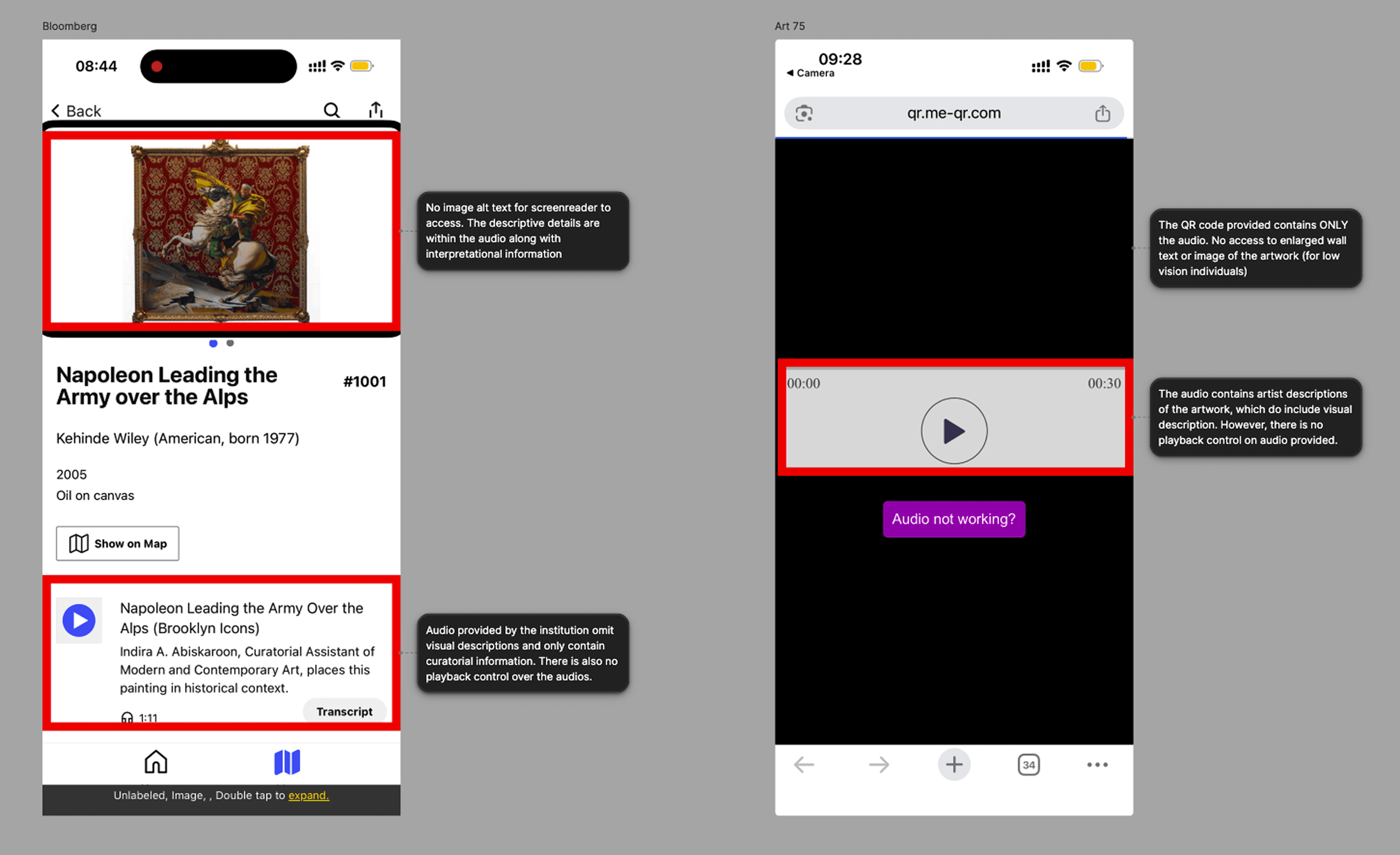
Across Bloomberg Connect and Art 75's existing setup, we discovered that both failed in providing high resolution image and visual descriptions.
Design Highlights
Artwork Details
Across Bloomberg Connect and Art 75's existing setup, we discovered that both failed in providing high resolution image and visual descriptions.
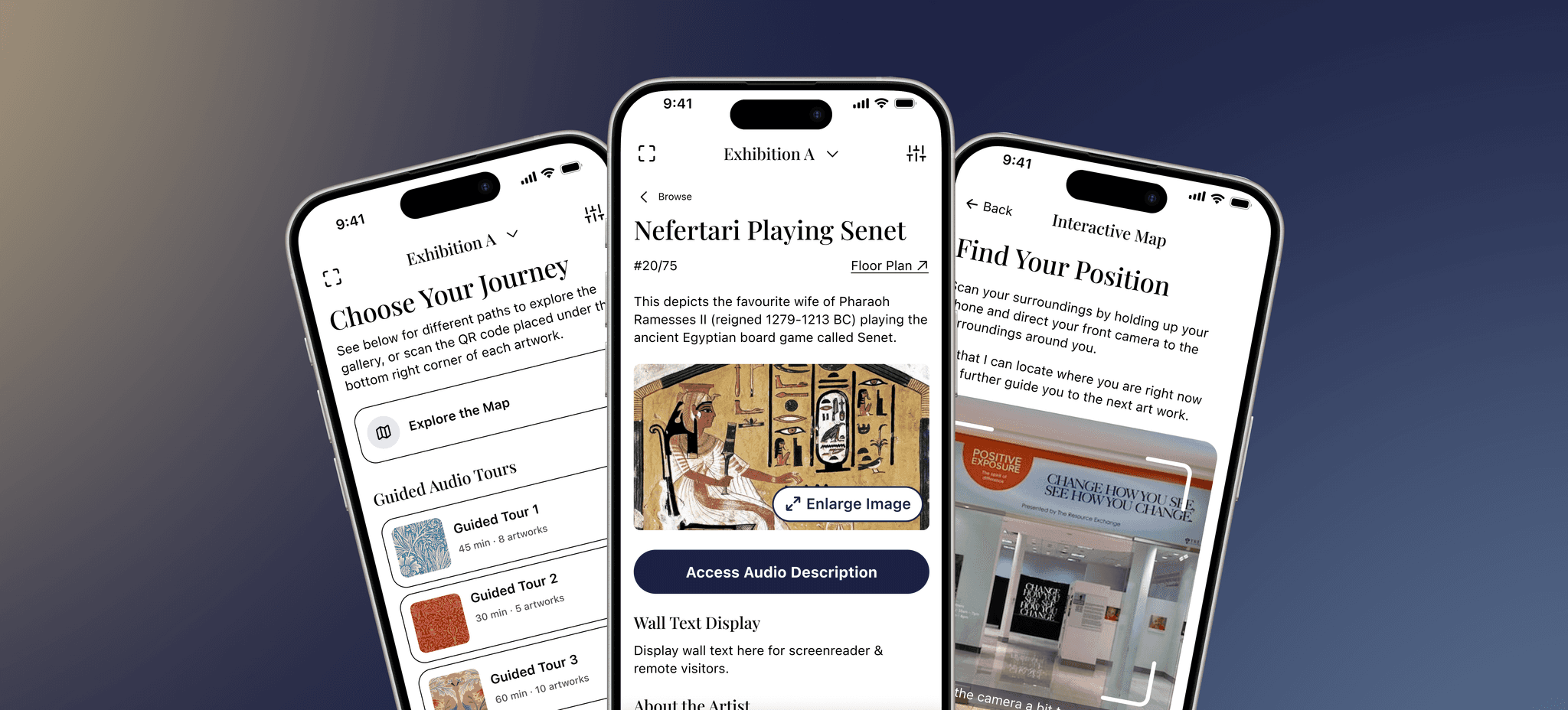
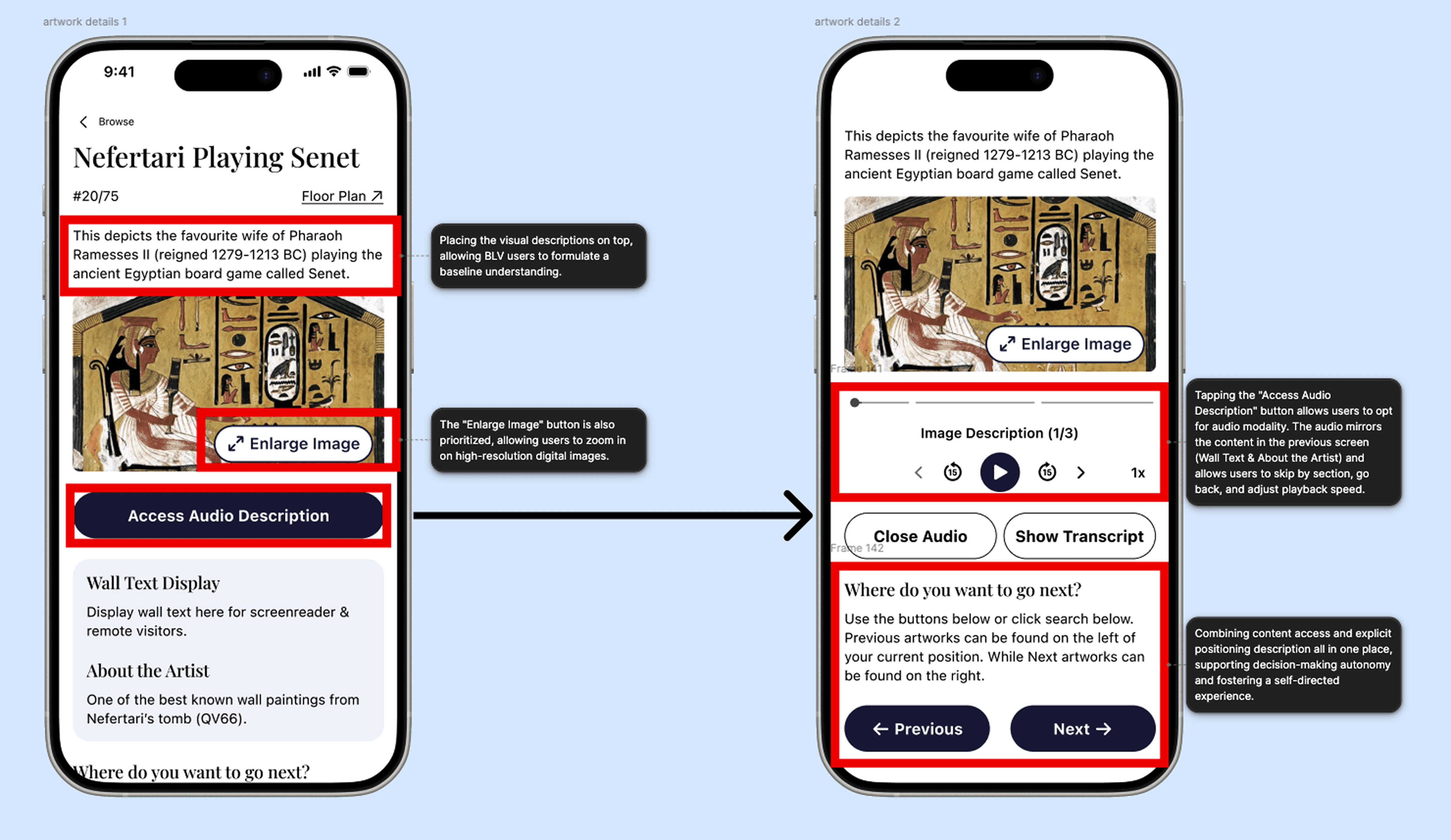
I took on redesigning artwork details page to bridge the existing gaps whilst also providing assistance across content and navigation, supporting user autonomy. The new design follows screen reader logic and allows for seamless switching between modalities (official audios, screen reader, or enlarged text/images).
I took on redesigning artwork details page to bridge the existing gaps whilst also providing assistance across content and navigation, supporting user autonomy. The new design follows screen reader logic and allows for seamless switching between modalities (official audios, screen reader, or enlarged text/images).
Flexible Access upon Entry
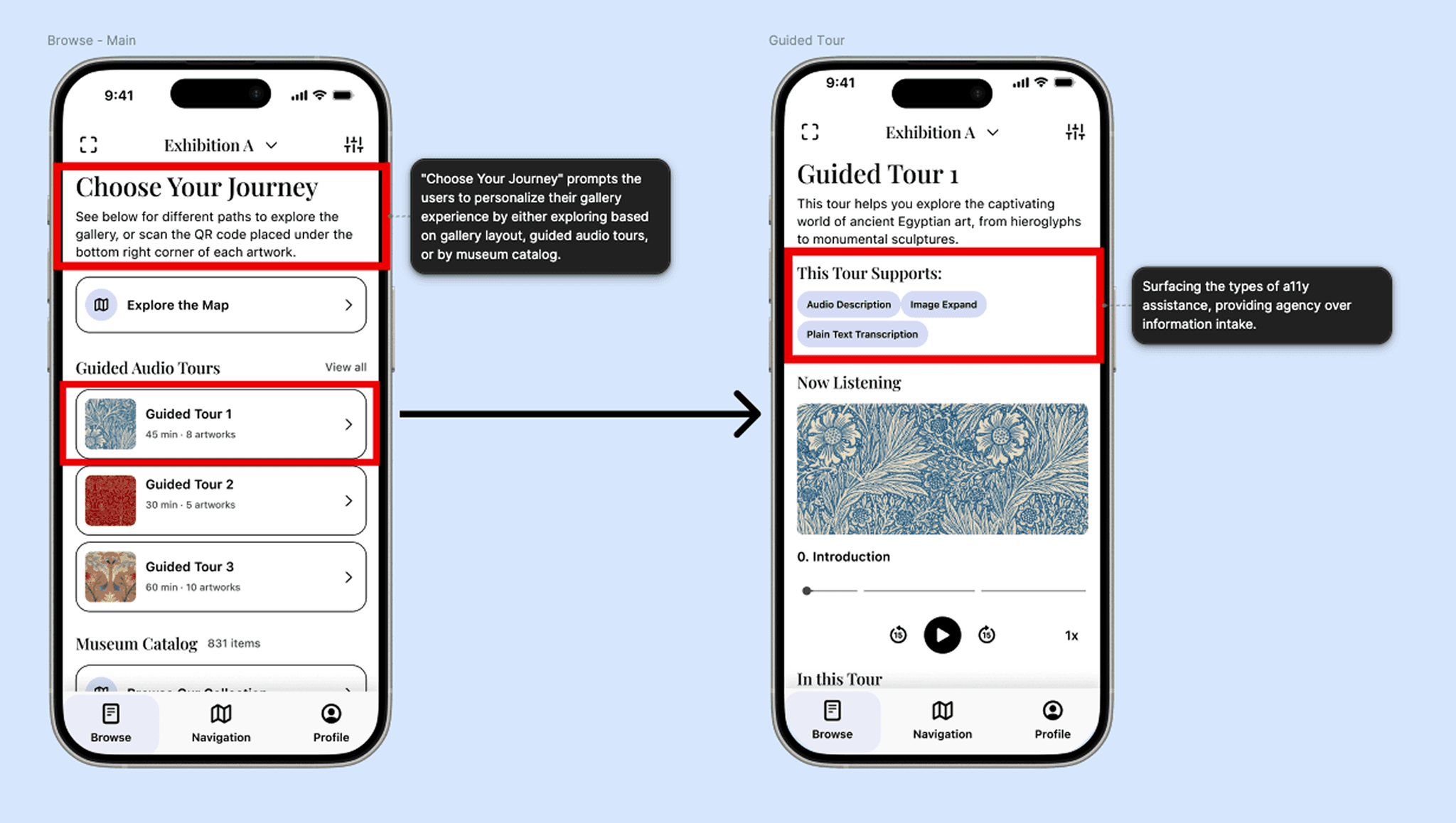
On a larger level, we aimed to provide user freedom and control over how they wish to access the entire exhibition. Upon entering the gallery space and the app, users can personalize their experience and modalities of accessing the artworks (by map, guided audio tours, or catalog) based on their own intent.
Flexible Access upon Entry
On a larger level, we aimed to provide user freedom and control over how they wish to access the entire exhibition. Upon entering the gallery space and the app, users can personalize their experience and modalities of accessing the artworks (by map, guided audio tours, or catalog) based on their own intent.
Real-time Navigation Assistance
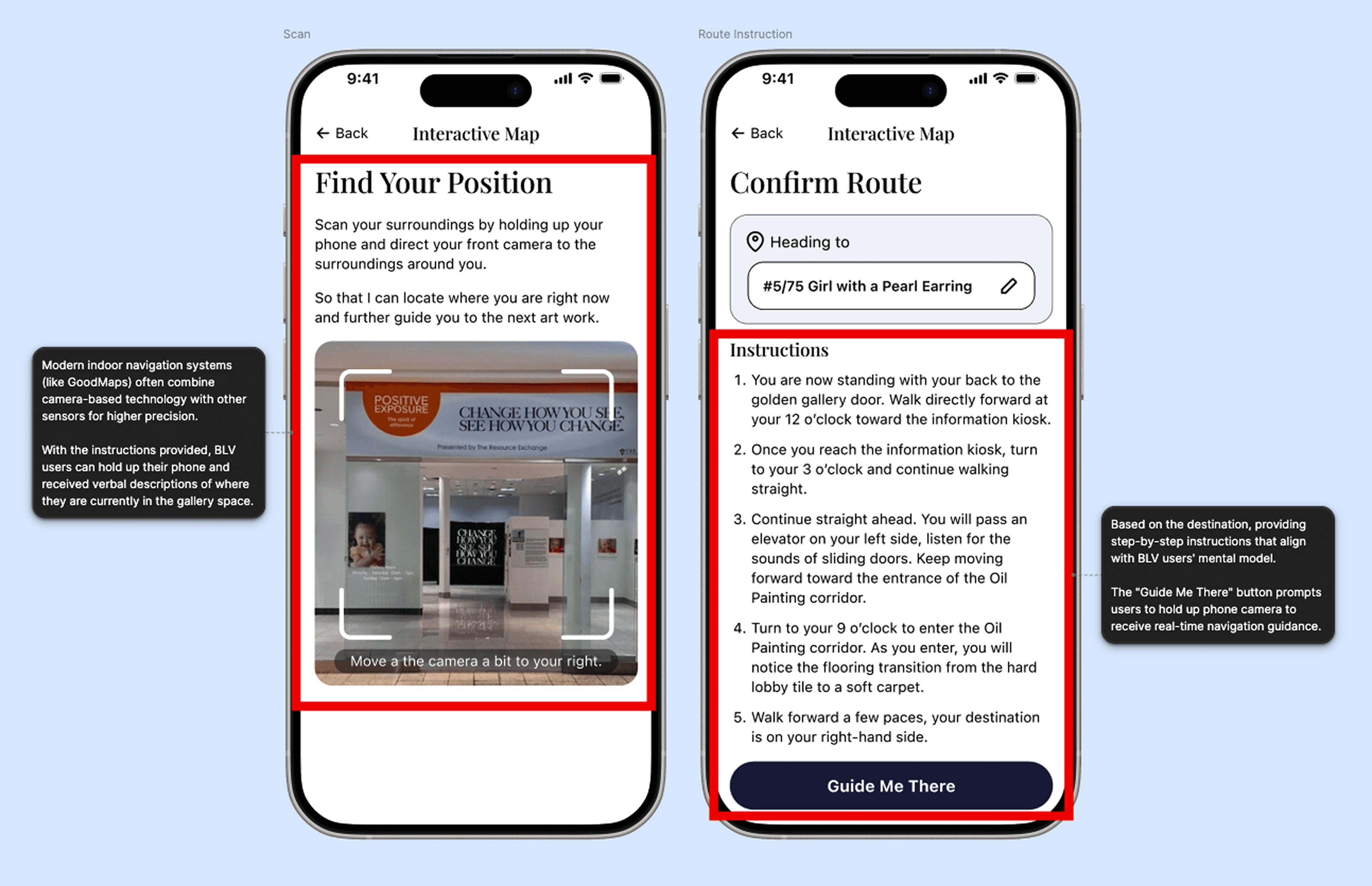
Following the same logic as existing tools (GoodMaps, Be My Eyes), users can use their phone camera to identify where they are and their immediate surroundings. From there, the app generates step-by-step route instructions calibrated to a BLV user's mental model: cardinal directions replaced by clock positions, landmarks made concrete through sound and texture cues, and spatial transitions called out as they happen.
Real-time Navigation Assistance
Following the same logic as existing tools (GoodMaps, Be My Eyes), users can use their phone camera to identify where they are and their immediate surroundings. From there, the app generates step-by-step route instructions calibrated to a BLV user's mental model: cardinal directions replaced by clock positions, landmarks made concrete through sound and texture cues, and spatial transitions called out as they happen.
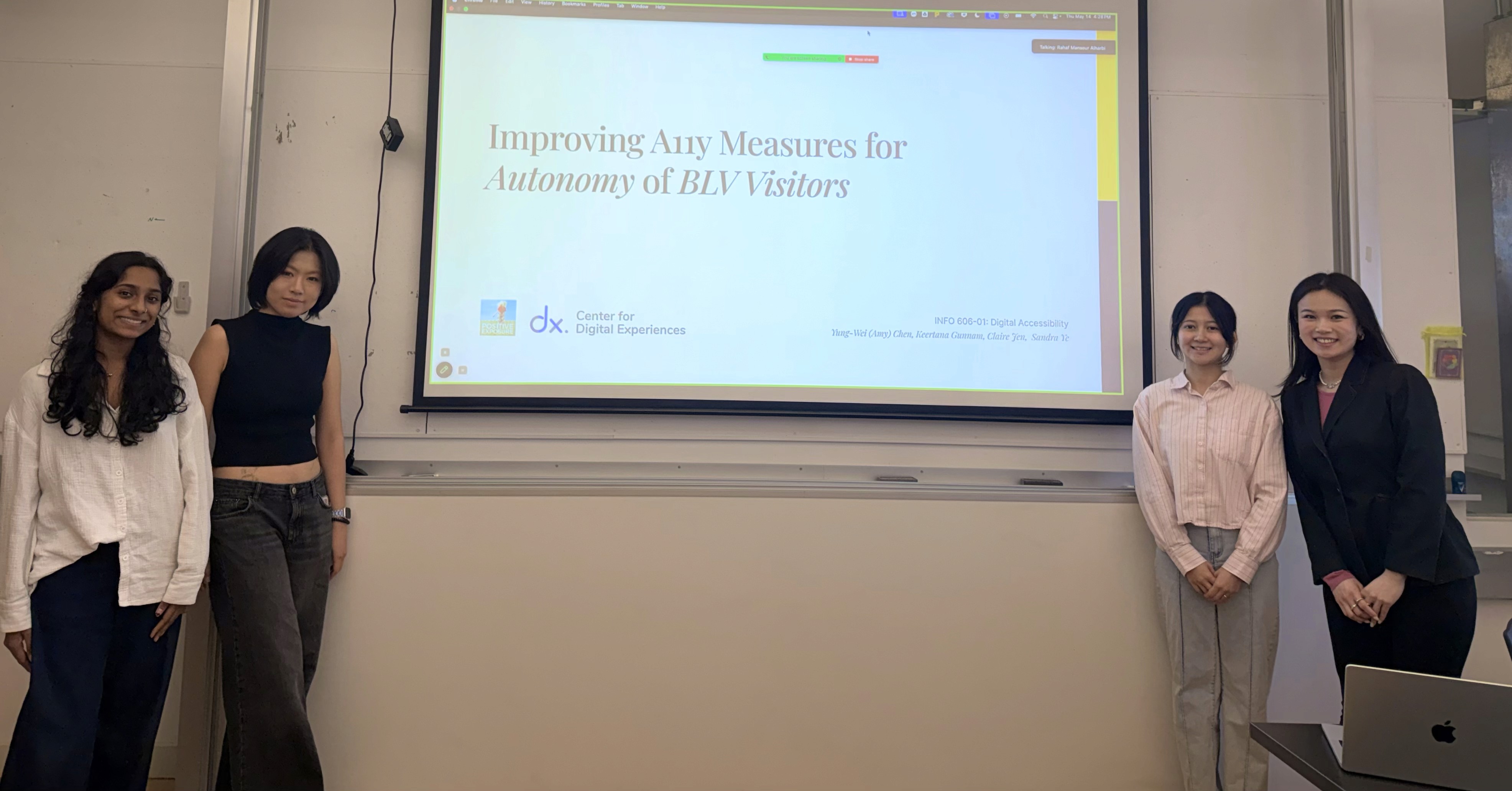
We presented our design and research to our peers, Professor Rahaf Alharbi, and Professor Liza Burroughs. Our slide deck will be passed along to Positive Exposure and Art 75 accessibility team.
We presented our design and research to our peers, Professor Rahaf Alharbi, and Professor Liza Burroughs. Our slide deck will be passed along to Positive Exposure and Art 75 accessibility team.
Next Steps & Reflection
Accessibility requires designing with, not for.
This project relied on secondary research and existing BLV accounts rather than direct co-design. This created a major constraint to our findings and proposed design. We hope to continue this work through direct partnership with BLV users, iterating via co-design sessions.
Realistic constraints mean solutions like this won't be adopted overnight.
Our speculative design shown above is intended to show the Art 75 and Positive Exposure leadership what could be possible when accessibility is approached as a design problem. Rather than suggesting immediate implementation, we hope to demonstrate a viable direction.
The same principles that shaped this tool could also extend to other institutions facing the same gaps.
Next Steps & Reflection
Accessibility requires designing with, not for.
This project relied on secondary research and existing BLV accounts rather than direct co-design. This created a major constraint to our findings and proposed design. We hope to continue this work through direct partnership with BLV users, iterating via co-design sessions.
Realistic constraints mean solutions like this won't be adopted overnight.
Our speculative design shown above is intended to show the Art 75 and Positive Exposure leadership what could be possible when accessibility is approached as a design problem. Rather than suggesting immediate implementation, we hope to demonstrate a viable direction.
The same principles that shaped this tool could also extend to other institutions facing the same gaps.
A special thank you to Amanda McFee, Director of Arts Programs for District 75, for her support and feedback; to Professor Rahaf Alharbi for her instruction; and to Claire, Keertana, and Amy for the many brainstorms and meetings and the open communication throughout!
A special thank you to Amanda McFee, Director of Arts Programs for District 75, for her support and feedback; to Professor Rahaf Alharbi for her instruction; and to Claire, Keertana, and Amy for the many brainstorms and meetings and the open communication throughout!